
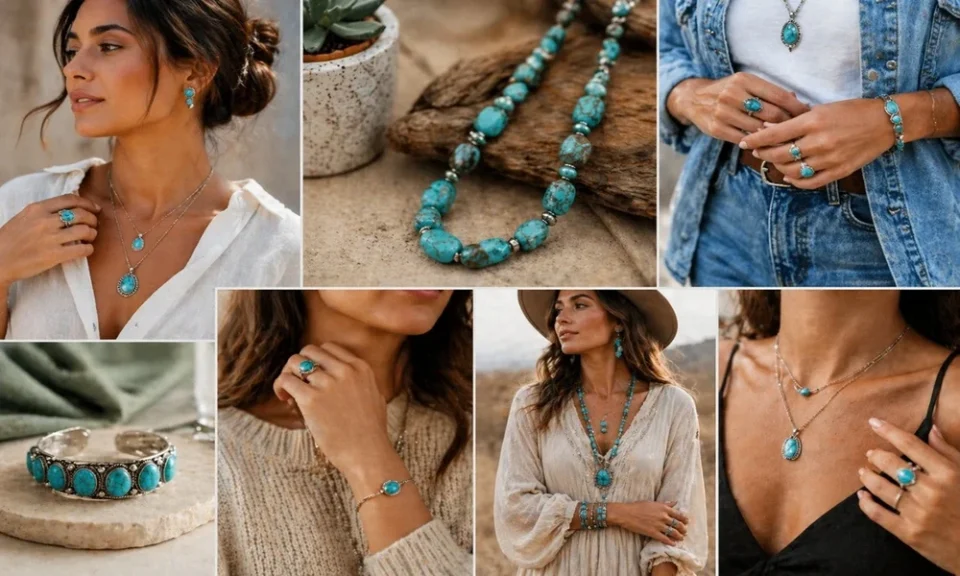
TL;DR: Turquoise jewellery works for summer because its blue-green tone sits against tanned or pale skin without clashing, and the stone’s opacity means it reads as a bold accessory rather than a sparkly one. The quickes route to a cohesive summer look is picking one turquoise piece as the anchor (a ring stack or a pair of earrings), matching the metal to your undertone, and keeping the rest of the outfit in linen, white, or sand tones so the colour has room to stand out. Gemondo’s turquoise jewellery collection covers rings, earrings and stacking pieces in both gold and silver settings, which matters because turquoise behaves differently against each metal.
Summer styling with coloured gemstones gets complicated fast because turquoise is more porous and lighter in colour than something like sapphire or ruby, so the rules that work for other stones do not automatically apply. This guide breaks the process into seven steps, covering what to wear turquoise with, how to layer it without overdoing it, and how to check a stone is genuine before it goes anywhere near sun cream or seawater. Each step is based on how the stone physically behaves, not just colour theory.
What You’ll Need
- At least one turquoise piece from Gemondo’s turquoise jewellery range (ring, earrings, or a stacking piece)
- A neutral-toned outfit base: linen, cotton, or chambray in white, sand, or soft grey
- A second, smaller turquoise or complementary gemstone piece if you plan to layer
- A soft polishing cloth for touch-ups during the day
- 5 minutes to check metal tone against your skin before you leave the house
Step 1: Pick One Turquoise Piece as Your Anchor
Decide which piece carries the colour for the day before you add anything else. Turquoise is opaque and matte compared with faceted stones, so it reads as a solid block of colour rather than a sparkle, and one strong piece does more work than several small ones scattered across an outfit.
This matters because turquoise’s visual weight is different from a diamond or a sapphire. A single turquoise ring or a pair of drop earrings will register from across a room, while a thin turquoise bracelet mixed in with five other bangles tends to disappear.
Start with either a ring or an earring, not both at full size. If earrings are the anchor, keep rings simple. If a ring is the anchor, keep earrings to studs or small hoops.
Expected outcome: one clear focal point of colour, with the rest of the jewellery supporting rather than competing.
Common mistake: wearing a turquoise necklace, ring and earrings together at equal size, which flattens the look and makes it hard to tell what the eye should land on first.
Step 2: Match Metal Tone to Your Skin and the Season
Turquoise sits differently against gold and against silver, and summer tanning shifts which one flatters more. Warmer, tanned skin tends to carry gold-toned turquoise jewellery better, while cooler or paler skin often suits silver settings, a distinction covered in more detail in Gemondo’s piece on turquoise jewellery in gold or silver.
Why it matters: a gold setting warms the blue-green of the stone, while a silver or white-metal setting cools it and makes it look closer to its raw, mined colour. Neither is more correct, but they photograph and read differently outdoors in bright light.
Hold the piece against your wrist or earlobe in daylight, not indoor lighting, since turquoise’s colour shifts more than denser stones under artificial light.
Expected outcome: a metal choice that holds up in outdoor summer light, not just under a shop’s spotlights.
Step 3: Build a Festival-Ready Ring Stack with Turquoise
This is the step most people get wrong, because turquoise rings are easy to overstack given how lightweight and low-profile most settings are. A stack of two or three works; five does not.
Turquoise stacking rings pair well with thin gold or silver bands in between, letting the turquoise pieces act as punctuation rather than filling every finger. Gemondo’s guide on turquoise rings for festival season breaks down specific combinations that hold up through a full day outdoors, which matters for festival and outdoor-event wear where rings get knocked against glasses, bags and tent poles more than in an office setting.
Start with one turquoise ring on the dominant hand, then add a plain band either side of it on the same or adjacent finger. Avoid putting turquoise rings on both hands at full stack depth, since it reads as costume jewellery rather than considered styling.
Check the setting type before stacking hard, open-stone pieces, since prong settings can catch on fabric and on each other during a long day. Bezel-set turquoise rings sit flatter and stack more safely for all-day outdoor wear.
Expected outcome: two or three rings that move as a set, not five rings competing for attention.
Common mistake: mixing turquoise with three or four other colourful stones in the same stack, which competes with the turquoise instead of framing it. Keep the rest of the stack in plain metal or one complementary neutral stone, not a rainbow of colour.
Step 4: Pair Earrings to Neckline and Hair, Not Just Face Shape
Turquoise earrings interact with hair colour and neckline far more than most guides admit. Drop styles suit an updo or hair pulled back, since the stone needs visible space along the neck to register; studs work better with hair down, where a drop earring would get lost.
A scoop or V-neck top gives a drop earring room to sit without visual clutter underneath it, while a crew neck or high collar pairs better with a stud or small hoop in turquoise.
Expected outcome: earrings that are visible and intentional rather than fighting with hair or collar for space.
Common mistake: choosing turquoise drop earrings for a high-neck outfit, where the drop gets hidden against fabric for most of the day.
Step 5: Keep the Outfit Base Neutral
Turquoise is already a strong colour statement, so patterned or brightly coloured clothing competes with it rather than supporting it. Linen, white cotton, sand, stone, and soft grey give the stone room to be the loudest element in the outfit, which is the point of wearing it.
Denim is the one exception that reliably works alongside turquoise, since indigo and turquoise sit close enough on the colour wheel to read as a deliberate pairing rather than a clash.
Expected outcome: an outfit where the turquoise is clearly the accent, not one of several competing colours.
Step 6: Confirm the Stone Is Genuine Before You Wear It Hard
Before committing a piece to daily summer wear, especially beach days and poolside events, confirm it is genuine turquoise rather than reconstituted or dyed howlite, since the two behave very differently under sun, chlorine and sweat. Gemondo’s guide on how to tell if turquoise jewellery is genuine covers the colour, weight and surface checks to run before a stone goes anywhere near seawater or sun cream.
Expected outcome: confidence that a piece can handle a full summer of outdoor wear without the colour changing or the surface degrading.
Common mistake: assuming all blue-green stones sold as “turquoise” are the real mineral; dyed howlite is common at lower price points and reacts badly to oils, sun cream and chlorinated water.
Step 7: Clean Turquoise Between Wears, Not After
Turquoise is softer and more porous than most gemstones used in jewellery, which means sun cream, perfume and pool chemicals sit on the surface rather than rinsing off easily. Gemondo’s guide on how to clean turquoise jewellery without damaging it covers the gentle, dry-cloth approach that avoids stripping the stone’s natural wax finish.
Expected outcome: the stone keeps its colour and sheen through repeated summer wear instead of dulling after a few beach trips.
Common mistake: using a jewellery cleaning solution or ultrasonic cleaner designed for diamonds or sapphires, which can strip turquoise’s finish and leave it chalky.
Troubleshooting Common Turquoise Styling Problems
- The stone looks dull in photos but fine in person. Turquoise shifts tone under flash photography; check it in natural daylight before deciding a piece isn’t working.
- Rings keep turning on the finger during the day. This is a sizing issue, not a styling one; a bezel-set ring that fits snugly stays put better than a loose prong setting.
- Earrings disappear with hair down. Switch to a slightly longer drop or move hair into a half-up style rather than sizing up the earring itself.
- Turquoise clashes with a patterned outfit. Swap the pattern for a plain neutral base; turquoise rarely pairs well with busy prints.
- Colour looks different after a beach day. Sun cream and salt water residue sit on the surface; a gentle clean usually restores the original tone.
- Stack feels heavy or uneven on the hand. Reduce to two rings maximum and alternate turquoise with a plain band rather than stacking stone-to-stone.
Tools and Resources
- Gemondo’s turquoise jewellery collection, covering rings, earrings and stacking pieces in gold and silver settings
- A soft, lint-free polishing cloth for daily touch-ups
- Natural daylight for checking metal tone and stone colour before wearing
- The genuine-stone checklist in Gemondo’s guide on spotting real turquoise, useful before any beach or poolside trip in 2026
FAQ
Does turquoise jewellery suit every skin tone? Yes, but the metal setting should change with skin tone; gold-set turquoise tends to suit warmer or tanned skin, while silver-set pieces suit cooler or paler tones.
Can you wear turquoise rings in the pool or sea? It’s safer to remove turquoise jewellery before swimming, since chlorine and salt water can affect the stone’s surface over repeated exposure.
How many turquoise pieces should you wear at once? One anchor piece, such as a ring stack or a pair of earrings, works better than turquoise rings, earrings and a necklace worn together.
Is Gemondo’s turquoise jewellery real turquoise or reconstituted stone? Checking a stone’s authenticity before buying matters regardless of retailer; Gemondo’s guide on confirming genuine turquoise covers the checks worth running.
What colours pair best with turquoise in a summer outfit? Neutral tones, white, sand, linen and denim, give the stone the most visual room; busy patterns and other bright colours compete with it.
Does turquoise jewellery need special cleaning compared with other gemstones? Yes, turquoise is softer and more porous, so it needs a dry-cloth clean rather than the ultrasonic or chemical cleaners used on denser stones like sapphire.
Final Word
Summer styling with turquoise jewellery comes down to restraint: one anchor piece, a metal tone matched to skin and season, and a neutral outfit base that lets the colour do the work. Gemondo’s turquoise jewellery range covers both gold and silver settings across rings, earrings and stacking pieces, which makes it straightforward to match the stone to skin tone without hunting across multiple retailers. Confirm the stone is genuine before a summer of heavy outdoor wear, clean it with a dry cloth rather than chemical solutions, and keep ring stacks to two or three pieces for an outfit that reads as considered rather than cluttered through the rest of 2026.
