
In today’s cultural landscape, a unique form of parody artwork exploring modern consumerism contradictions has emerged. This practice uses humour as a sharp tool. It holds a mirror up to our society and breaks traditional artistic boundaries.
The link between creative expression and the buying and selling of goods has always been complex. Artists are both fascinated and critical of the consumer culture that shapes our world. This tension forms the core of much contemporary art.
Such creations function in two powerful ways. They entertain with their visual wit while provoking serious thought. They ask viewers to reconsider their own role within systems of mass production and digital commerce.
A key question remains. Does this art celebrate the world of shopping or condemn it? Often, it occupies a more nuanced, ambivalent space that resists simple answers.
Key Takeaways
- This art form acts as a critical lens on our relationship with buying and selling.
- It combines visual appeal with sharp social commentary for modern audiences.
- Artists have a long history of engaging with, and critiquing, consumer culture.
- The work serves to entertain, provoke thought, and document the evolving art-commerce relationship.
- It often presents an ambivalent view, neither purely celebrating nor condemning.
- This practice is a significant part of today’s broader contemporary art movements.
- It directly engages the public, encouraging a re-evaluation of daily choices.
Introduction: Unpacking Parody Artwork and Modern Consumerism
Visual satire has long served as a mirror to society’s buying and selling rituals. This creative work uses the familiar language and imagery of brands and adverts. It decodes the complex systems that fuel material desire in contemporary life.
For artists, this culture of consumption is both a rich subject and a direct target. They walk a fine line. Their pieces often borrow from commercial visuals to deliver a sharp critique. This creates a fascinating tension within the art itself.
Humour here is a strategic tool. It sparks conversation and challenges perspectives. Collectors are frequently drawn to pieces that entertain while holding a deeper, lasting message. This ensures the work’s relevance endures.
Today’s consumer culture presents new contradictions. From digital-age excess to environmental concerns, these provide fertile ground for commentary. Contemporary artists engage with these themes differently from past generations.
Understanding this art is key. It is serious cultural analysis disguised as wit. It asks the audience to question their own values and the very distinction between high and low art.
Historical Perspectives on Pop Art and Consumerism
Following the austerity of war, Britain’s economic revival paved the way for a new artistic movement deeply engaged with commercial imagery. Known as Pop Art, this 20th century phenomenon uniquely reflected the objects of everyday life.
It celebrated and criticised the mass-produced goods flooding society.
The Rise of Consumer Culture in Post-War Britain
The end of rationing brought sudden abundance to British life. American cultural influence introduced new patterns of consumption.
British artists reacted with a more sceptical eye than their US counterparts. They used their works to question this new consumer culture.
Richard Hamilton’s seminal 1956 collage was a foundational painting in this style. It presented an idealised domestic scene packed with advertised products.
| Aspect | British Pop Art | American Pop Art |
|---|---|---|
| Primary Stance | Critical, questioning | Celebratory, ambiguous |
| Key Themes | Anxiety of abundance, class | Celebrity, mass production |
| Representative Artist | Richard Hamilton | Andy Warhol |
| Typical Medium | Collage, painting | Silkscreen, painting |
Evolution from Classic Pop to Contemporary Parody
The movement evolved beyond simply reproducing commercial imagery. Later artists began to deconstruct the mechanisms of desire and value.
This shift laid crucial groundwork. The visual vocabulary of classic Pop Art informs today’s critical style.
Contemporary work now tackles complex issues like globalised capitalism. It builds directly on this historical engagement with consumer culture.
The Satirical Language of Parody: Totally Justified Hypocrisy UK Insights
Inherited from past masters, irony serves as a powerful tool for modern commentary on material desire. Humorous art has deep roots, seen in Renaissance exaggerated portraits.
This historical style informs today’s sophisticated visual language. Contemporary British artists have refined this ironic approach.
They build upon the ambivalent attitude of earlier movements. Their work layers meaning and resists simple interpretation.
Cultural Relevance and Inherited Irony
This art stays powerful by connecting to current issues. It references adverts and brand controversies audiences know.
Inherited irony acts like cultural DNA. Each generation complicates the satirical techniques of the past.
The movement known as Totally Justified Hypocrisy UK exemplifies a key contradiction. It creates critical art within commercial markets.
| Era | Primary Technique | Key Focus | Representative Example |
|---|---|---|---|
| Renaissance | Exaggerated Portraiture | Escapism, Social Satire | Leonardo da Vinci’s Caricatures |
| Pop Art | Appropriation of Imagery | Mass Culture & Ambivalence | Andy Warhol’s Campbell’s Soup Cans |
| Contemporary | Logo Subversion, Visual Puns | Systemic Critique of Consumerism | Totally Justified Hypocrisy UK artists |
Specific techniques include visual puns and recontextualised products. These communicate complex critiques better than direct condemnation.
A major challenge exists. The artwork often becomes part of the very consumerism it questions. Artists must navigate this culture carefully.
Exploring “parody artwork exploring modern consumerism contradictions”
Artists worldwide now dissect the complex machinery of buying and selling that defines our era. This consumer lifestyle, once seen as American, now shapes the entire world.
Figures like Gabriel Kuri and Josephine Meckseper create contemporary art that questions this system. Their work examines the labour behind goods and the global networks that move them.
They target clear tensions. One is the promise of personal expression through identical, mass-produced objects. Another is the talk of sustainability versus the reality of wasted products.
This art acts as a diagnostic tool for society. It helps people see their own role in these cycles. Humour makes the sharp critique engaging, not a lecture.
The artwork reveals how consumer culture assigns value. It shows how we use objects to build who we are. This creates a powerful mirror for our times.
Artist Case Studies: From Banksy to Jerkface
Several prominent creators today use humour and familiar symbols to question our materialistic habits. Their pieces serve as direct case studies in critical engagement.
Contemporary Pioneers Challenging Consumerism
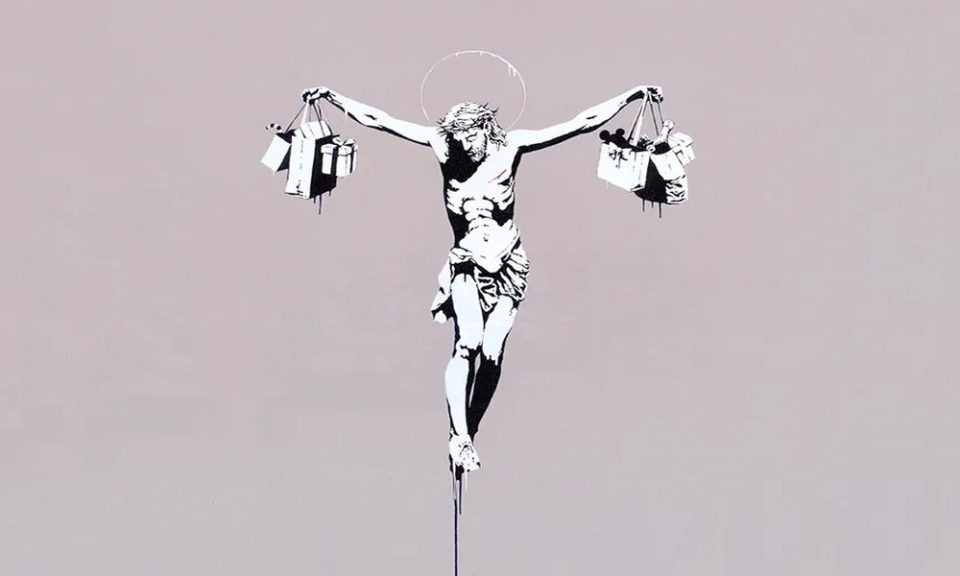
Banksy’s stencil Jesus Christ with Shopping Bags is a stark visual. It replaces spiritual iconography with branded carriers.
Jerkface distorts beloved cartoon figures. This approach comments on how nostalgia is sold back to the audience.
Mr. Brainwash’s Banksy Thrower swaps a floral bouquet for a manual. It cheekily questions who creates art and why.
Ron English hijacks public ad spaces. His ‘POPaganda’ inserts corporate mascots into classic scenes.
Ross Muir blends traditional portraiture with contemporary logos. His work creates a tension between historical and current value systems.
Distinctive Techniques in Parody Artwork
These artists employ specific methods to deliver their messages. Stencilling allows for speed and replication.
Appropriation borrows from mass culture to critique it. Distortion makes the familiar imagery strange.
Mash-ups combine disparate elements. Recontextualisation places objects in unexpected settings.
| Artist | Primary Technique | Example Work |
|---|---|---|
| Banksy | Stencilling | Jesus Christ with Shopping Bags |
| Jerkface | Distortion & Appropriation | Various cartoon character series |
| Mr. Brainwash | Mash-up & Recontextualisation | Banksy Thrower (2017) |
| Ron English | Billboard Hijacking | Super Supper series |
Each technique serves a unique critical purpose. They help communicate different aspects of our commercial world.
This style often references the legacy of figures like Andy Warhol. It operates within the fine art market while questioning it.
Their works and paintings are visually compelling. They also function as pointed commentaries on the systems they inhabit.
Social Commentary: The Role of Humour in Art
Humour in creative works acts as a Trojan horse, smuggling complex commentary past an audience’s defences. This strategic approach disarms viewers, creating an opening for reflection that more confrontational art might foreclose.
Laughter creates a moment of cognitive dissonance. It interrupts habitual thinking, allowing people to see familiar aspects of their culture from a new, unexpected angle.
This method has deep roots. The Dadaists used absurdity to rebel against societal conventions a century ago. Marcel Duchamp’s Fountain famously mocked artistic authority, a pioneering act that influenced later pop and contemporary practices over time.
By making difficult truths palatable, humour allows a critique to circulate widely. It captures attention and reaches an audience that might resist overtly political messages.
This wit also has a democratising effect. It can make conceptually sophisticated fine art feel more human, relatable, and accessible without sacrificing its intellectual rigour.
A risk remains, however. The joke might be enjoyed while its underlying, sharper point goes unabsorbed. The humour must be crafted to energise, not defuse, critical thought.
Consumerism and Irony: Totally Justified Hypocrisy in Focus
A decisive shift occurred as artists began to deconstruct consumer culture from within its own visual language. Moving beyond pop art’s playful ambiguity, they adopted a more critical stance. This approach embodies the complex idea of Totally Justified Hypocrisy.
It acknowledges the inherent tension of critiquing a system while participating in its market.
Critiquing Market Culture and Mass Production
These creators target advertising’s psychological mechanics and the environmental cost of mass production. Their strategies are direct and multifaceted.
They appropriate brand imagery to subvert its original message. Other works expose the hidden manufacturing processes behind polished products.
Some reveal the exploitative labour conditions in global supply chains. A common tactic uses cheaply made objects and synthetic materials as the artistic medium itself.
This turns the symbols of overconsumption into a powerful critique.
| Strategy | Primary Method | Critical Focus |
|---|---|---|
| Brand Subversion | Appropriating logos and adverts | Psychological manipulation of desire |
| Process Exposure | Revealing manufacturing stages | Environmental impact and waste |
| Labour Revelation | Highlighting supply chain conditions | Human cost behind cheap goods |
| Material Embodiment | Using discarded consumer objects | Contradiction between appeal and harm |
Impact on Contemporary Art Movements
This self-aware, ironic approach has significantly shaped recent art movements. Post-internet art engages deeply with digital commerce and online identity.
Social practice art often critiques urban gentrification and the commodification of space. The market‘s absorption of such critical artwork creates a ongoing dialectic.
It validates the critique while potentially neutralising its force. This tension between resistance and recuperation defines much contemporary art today.
Critical Perspectives on Art and Society
Scholars continue to dispute the true intent behind iconic pieces that feature branded imagery. This debate shapes how we view art and its role in society.
A key fact is that critics disagree whether Pop Art critiqued or celebrated consumer culture. It certainly illuminated materialism.
Reassessing Iconic Parody Artworks
Revisiting seminal works reveals shifting interpretations. Andy Warhol’s soup cans are seen as both celebration and critique.
Barbara Kruger’s bold text piece, I Shop Therefore I Am, questions identity through purchase. Its meaning evolves with the culture.
The 1964 exhibition Mythologies Quotidiennes was pivotal. It showed consumer goods replacing traditional symbols.
“The new visual culture of mass media seemed to be replacing the icons of myth and history.”
This show featured artists using found objects. They re-presented real life with a satirical tone.
| Artwork | Artist | Common Interpretation | Critical Debate |
|---|---|---|---|
| Campbell’s Soup Cans | Andy Warhol | Documentation of banality | Celebration vs. critique of mass production |
| I Shop Therefore I Am | Barbara Kruger | Feminist critique of consumer identity | Empowerment or indictment of shopping? |
| Mythologies Quotidiennes pieces | Nouveau Réalisme group | Satirical re-presentation of rubbish | Elevating trash to high art |
These works gain value through ongoing reassessment. Their image in the public eye changes over time.
Totally Justified Hypocrisy UK Revisited
British creators exhibit a unique attitude. They blend ironic distance with complicit participation.
This approach defines the Totally Justified Hypocrisy UK stance. It acknowledges the impossibility of standing outside the system.
The most successful artwork resists definitive interpretation. It functions as aesthetic object, cultural document, and provocation.
Innovative Techniques in Parody: Mixed Media and Typography
Beyond traditional painting, contemporary creators are turning to words and objects to deliver sharp social commentary. This approach defines a key style in today’s critical art.
Mel Bochner, based in New York, doesn’t just use words-he weaponises them. His bold, graphic pieces turn language into something visually striking. The ‘Blah Blah Blah’ series is a prime example. It turns a dismissive phrase into an aggressive visual mantra.
Barbara Kruger’s graphic design work is equally direct. Her famous 1987 piece, Untitled (I Shop Therefore I Am), appropriates advertising’s visual language. It subverts the very message it mimics.
The Role of Totally Justified Hypocrisy in Mixed Media
This ethos of Totally Justified Hypocrisy is clear in mixed media art. Artists embrace contradictory materials and methods. They refuse pure style.
The Connor Brothers perfect this. Their work pairs vintage imagery with deadpan text. This creates a seductive yet subversive series.
Mixed media lets artists embed real consumer objects. These assemblages transform products into critical art. They comment on their own status in our modern consumerism.
These techniques expand the possibilities for parody artwork. They address the complex contradictions of digital-age culture.
Conclusion
Ultimately, this creative practice’s value lies in amusing and provoking. It offers a critical lens on society and consumer culture in everyday lives.
The journey from 20th century Pop Art to today reveals an ongoing dialogue. Artists like Andy Warhol in New York started this movement. Their work focused on mundane series of objects.
Looking forward, art will adapt. Its commentary is crucial for today‘s world. Museum exhibitions provide educational value about commercial landscapes.
A key fact is its circulation within markets. This part of its nature does not reduce its impact over time.
Over the years, it has made fine art accessible, bridging high art and public attention. It maintains tension, refusing simple answers. As long as consumer culture exists, this creative series will continue, with new figures emerging.
